Wednesday, July 08, 2009

Home again, home again, jiggedy-jig


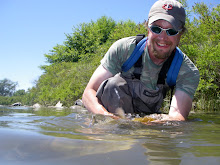
First MN carp caught after Pacific NW Epic. Scaled: 15 lbs.
Ate SJW without hesitation. Hooked one bigger than this just prior: burned my index finger and broke off the carp carrot trailer.

Thursday, July 02, 2009

Part I: The Place

Any good story is in large part dependent on its setting. Hoosiers wouldn’t work if it were set in New York City, No Country for Old Men would be garbage if it took place in London and The Thomas Crown Affair would be awkward if Brosnan and Russo had met at the Perkins in Grand Rapids, MN. We know that for sure. For this adventure we just completed then, a brief discussion of the place is appropriate as prelude to the meat of the story.

Thinking of the Columbia River now, here is what I remember, in no particular order: strong flow, steep sided gorge, red-brown slopes with long-ago cut gullies and larger ephemeral channels, clear water, open land, sage bushes, big dams. Thinking now that that is a pretty good recollection, given that my mind was 99% on carp for the entire trip, and thus my eyes were on water nearly every minute. I wasn’t journaling or taking soil samples. I did lift my head often enough to look around and soak in some imagery it seems. John Montana calls it high desert. What an interesting contrast to our own Ole Miss: heat, scrub, scrabble, snakes, clear water vs wide, forested floodplains, sloughs, oxbows, mosquitoes and houseboats.

JM and others have referred to the Columbia as the Mississippi of the Northwest. I thought about that a while and noted that it did look big like the Miss, but I knew it didn’t drain near as much land. In fact, the entire river drains 265,000 square miles; Miss is at 1,245,000 square miles. Roughly 5x difference there. Lengthwise: Columbia is 1,243 miles; Miss is 2,320 miles – roughly 2x. It gets more interesting when you consider typical discharges at various points in the watersheds:

Columbia River at the Dalles: right now around 300,000-400,000 cfs
http://waterdata.usgs.gov/nwis/uv?14105700
DRAINAGE AREA.--237,000 mi2, approximately.

Here is a USGS site on the Miss that is roughly equivalent to that discharge – note that drainage area is almost 3x though:
Miss at Chester IL
http://waterdata.usgs.gov/nwis/nwismap/?site_no=07020500&agency_cd=USGS
200,000-300,000 cfs
Drainage area 708,600 square miles

Here is a little closer to home:
Miss at Clinton, IA
Contributing drainage area 85,600 square miles
~60,000 cfs
http://waterdata.usgs.gov/nwis/uv?05420500
In comparison, Columbia at The Dalles is ~3x larger drainage, but 5-6x more flow.

Water yield is dependent on drainage area, climate, precip, runoff coefficient, evapotranspiration, etc. You kind of know this, but to see a different river up close and personal is very educational.

Anyway, this seems to fit with what the Columbia feels like when you stand in it or observe it: pretty big and strong. And a couple key notes: very wadeable, and many flats. That’s the draw here – what can drive two guys to fly across the country to premiere coldwater fishing and skip it in favor of carping: outstanding sight fishing in clear water to beautiful, strong fish. Plenty of them.


Here are a couple good summaries of the Columbia River basin:

http://www.blm.gov/education/00_resources/articles/Columbia_river_basin/article.html

http://vulcan.wr.usgs.gov/Volcanoes/Washington/ColumbiaRiver/description_columbia_river.html

Part II: The Fish

There is no freshwater fish like the carp. I consider myself moderately qualified to make that statement. Not perfectly qualified, but moderately so, and confident enough to take the scope of the fishing I’ve done and make a bit of an extrapolation: there is no fish in inland waters that is like the carp. I have love and respect for any and all fishes. I tackle smallies. I’m thrilled by the idea of catching northern pike on flies. Panfish on poppers. Trout are my beautiful brothers and sisters. They aren’t carp though. I sure want them to act like carp. In recent years I’ve been begging BWCA fish to step up and fight like a carp but it ain’t gonna happen. Not ever. When carp are handing me my ass, I often find myself making a mental note: do more trout fishing – it’s a lot easier. "Gamefish" take a backseat to the ridiculous tenacity of The Gray Ghost. Likewise, the other fish that are commonly grouped into the “roughfish” family are a step down: no quillback, buffalo or sucker could ever dream of staging a run like a carp. Thinking back on Buffalo Days 2007, those brutes were near-impossible to land, but it was due to simple mass – not athletic ability, endurance or attitude. This power then, is the identifying feature of the carp, as far as I can tell. It’s the lead on quite a list of attributes though:

(1) Power and endurance: through your line and most of your backing can an average carp go if he has the room.
(2) Size: they get big. Sometimes really big.
(3) Feeding mechanics: they have a “feeding cone” or cone of sight that must be intersected by your fly. It is rare that any carp will do you a favor and chase your offering.
(4) Spookiness: the carp is a discerning creature. If your fly splashes, or sinks too fast, or if you push too much water toward the fish… you look for the next target.
(5) Method of ingestion: there is no strike. It’s an eat. Usually nothing violent or sudden (some exceptions), and very rarely anything that you feel.

Add up all those tiddy-biddies and you have quite a fish. Definition of unique in the world of freshwater fishing is what that list sums to, I’d say. And that segue ways to:

Part III: The Method

Nobody on this trip was asking the carp for a damn thing. No favors requested. There was no waiting for fish to come by, no requesting that a fish catch a scent and swing through for a taste. No reaction to a noisy or flashy lure was sought. No drifts over or though a good hole were cast out with a letter attached: please eat. No fuggin favors. It was a hunt, plain and simple. The areas selected were known hangouts. Stalking methods were employed. Decisions were required: does one cast now at a higher degree of difficulty, or sneak closer and risk spooking the fish? What flies to use – splashiness vs sink rate? Once those items are cleared up, the next set of more difficult questions comes to light: where does one lay the flies – right on head, or out a bit? Which of those fish is most likely to eat this fly? Did that fish move to the fly? Did he eat? And the kicker: sometimes you are working your way through those questions while looking at nothing more than a stream of bubbles emanating from a silt plume. Hehe.

Very clearly, the fish win this numbers game. More missed fish than caught fish (particularly by some of us - to be exact by two of the three of us). In fact, more missed fish than we know: many eat and spit while we sit and stare in wonder. In this method, half-guesses are common, and full-out-guesses are required now and then. Set the hook. Pick up that rod. Raise it and feel that glorious resistance and the thrubbing of a connected fish. Revel for just one moment in the coming-together-of-it-all though because now the details of the method have passed and you’ve looped back to Part II: The Fish. You’ve got a fuggin carp hooked and your line is peeling away from you so fast it’s burning your index finger. Palm the reel and engage. Duel this brute of a fish to your hand, take a picture by which you can remember his brilliance and then let him go.

So that's why a couple guys spent some money to fly to the trout-fishing Mecca of the US to fish carp. The fact that a good friend is home-based in PDX and stacked with beyond-guide skills made it all the better. The rest can be told by way of pictures.

Consider the fact that three trigger-happy dudes were walking flats four four days straight (12 hours each day) armed with cameras... It follows that there are a lot of images. The only feasible means by which I can post a few of them here is to create general categories and then just load them in no particular order. The logical proceeding seems to be:

BENT RODS
EATEN FLIES
FIRST FISH FOR JOE
FISH
DOUBLES, TRIPLES
FUNNY
OTHER COOL SHOTS

With that, here are the BENT RODS:


EATEN FLIES


FIRST CARP ON FLIES FOR BROTHER JOE


THE FISH


DOUBLES, TRIPLES


FUNNY


OTHER COOL SHOTS


May add some captions later. Fugging blogging is a lot of work. Skipped lunch to complete this... geez.

Thanks John Montana for hosting another great trip. It's always a pleasure.

Wednesday, June 24, 2009

I gotta pocket full of stones...

Or a suit case full of kick ass carp flies.


N.O. L.I.M.I.T - Robert Griffith

And some last minute tuning of gardens: thinned some beets (eating the greens for lunch right now) and worked some tomatoes around in the cages. As you can see, some of the tomato plants are waist high by the -6th of July. The grapevine is screaming for a trellis. Working on that one.


Cylindria beet from Seed Savers Exchange. Got some bigger ones coming along.

Sunday, June 21, 2009

06.21.09


Symbolic: come unprepared for carp and things must be shoe-laced together. No belt; no fighting butt; 4 wt rod; 3x tippet; no wading staff.


Main goal: MET. A new carp on the fly guy born. This fish was filter feeding just below the surface. Put on zebra midge and within 1-2 minutes, Joe had it in a fish mouth.


When's the last time you've done this?: stood in strong current, on treacherous rocks, holding a ~15 lb carp on a 4 wt in your left hand while taking photos of your fishing buddy with your right hand and also preparing to net his fish.

Worth it though, no question.

We do more carping before 7 AM than most people do in a week.

Friday, June 19, 2009

Appetite: Whetted


Take a second to stare at human hand for scale. Adult, male human hand.

Big fuggin fish. Scaled it.

Tuesday, June 16, 2009

LOD: Back to Roots


Bumped a Couple Carp Yesterday

Came off to be tougher than I figured it would be: cloudy conditions made for poor visibility, and the fish were spooky. None of the slow cruisers would give my flies any consideration. In fact, they bolted at the sight of them.

The first fish pictured below doesn't really count, because I was fishing to another when this one shot in from the side to eat the LOD. I scaled it at 6 lbs.

The second was one of the few tailers I saw (in the brief 1.5 hours of fishing on this day). I put this new fly on him, drug it to position and dropped it just in front and to the side. His tail was to me, so I didn't get to see the take but I saw the take (you know what I mean). This was a small fish, so I decided he ought to come home with me to provide some sustenance - more on that in a later post.

Related report: my neighbor has been prowling this location a bit too, and he recently banked his first carp on the fly there... and to boot: probably the first ever carp caught on a Bogdan reel.


Monday, June 15, 2009

Throw a Dart

Exhaling now, after a long, filled weekend. It included various forays into home projects, gardening, eating Driftless Area food, parties, canoeing with kids and a couple stints of fishing. This being the venue that it is, I'll stick to the latter-most item going forward.

Sunday morning: slipped out of bed at ~4:47. Stole out the back door around 5:25 and was on the stream before 6:00. In fact, I may have had my first fish to hand before 6:00. By 7:00 I figure I must have had ~8-10 trout on the books. That is a solid formula for really fishing the subsequent hours in relaxed fashion. Fish have come, from there on everything is some beautiful icing. I put quite a few pictures below - maybe caption approach is the best way to tell this story. It's a good story too: I'm fully realizing that these little outings are what constitute Trout Season 2009. Too often a guy finds himself looking forward to the next day on the water... and forgets to savor the last one he logged. This outing was by no means any sort of pinnacle, but it was a step beyond solid and I appreciate it for the quality it provided.

A lot of this: humming 2 wt. For a while the moon was in the western sky and I was fishing the east bank of the stream... so I'd look up at my bent rod and see La Luna working his way down to the horizon.

One tandem rig was fished all day: two BH PTs. I stock a generic black BH nymph that is essentially a PT with a couple steps omitted... that fly absolutely wrecked havoc on this day - you'll note in the followig pics: all the same fly embedded in lips. In a strange twist - never lost one fly. All snags pulled through or out. Looking at these pics - I guess I like headshots over the body-laying-in-grass poses. Seems like when I get the fish to hand I'm always trying to capture the spots and colors... can't ever do it just right though.


For some reason I was able to call almost every shot on this day. I was seeing the water and feeling where the fish were... and getting the nymphs on them. I mention that because it doesn't come together like that all too often... so there was a really slick feel to this outing: everything was hitting. I walked up to this pool and said to myself fish at the head and fish in the tail. I flipped the nymphs at the head, and was treated to a vision of a dark shape move from its hold to eat the trailing PT. The fish in the tail of the pool I fooled into eating a nymph, but missed.

Speaking of that - a couple notes on visuals and takes: I was able to watch quite a few nymph takes - pretty cool. I saw numerous fish move to eat. Also, the lift was very effective - at the end of drifts, a slow raise would bring hard hits - a few of which I was able to watch.


Time to tie up an inch worm pattern. Those are two different trout stomachs. Interesting to note that I turned over a dozen rocks and saw no mayfly nymphs. Hell, I saw almost nothing on the rocks. A few caddis here and there, and some leeches. Kind of eerie really. Rocks should hold bugs. So few bugs on the rocks, and these two fish eating inch worms and snails.


Fish from all kinds of water types: many out of reaches like this one below: subtlely deep, with a trace of a foam line. Took quite a few out of really deep, slow water. I think I could have sat on that stuff for a long time and really pulled out a lot of fish.

Around 8 AM I saw just a few mottled brown caddis #16 in the air. A little later I found some rising fish, so I put on a brown caddis with a #20 PT dropper (no BH). Picked up a few fish on that rig, including one on the dropper. One beauty came from the only shady spot in a sunny reach - put the caddis under an over-hanging shrub and watched it be crushed on lighting on the water.

Tell me this doesn't get you going:


One other interesting note: all of the fish were one of two sizes: ~6 inches, or 11-12 inches. Maybe two year classes that have done well there... No fish into the teens, and not even any 8-9 inchers. An absolute brigade of strong and pretty foot long fish though - enough to keep a sap like me interested for the duration. I definitely did not count the fish, but I will say with 100% certainty that rounding to the nearest 10, the tally would be 20. I'd guess maybe a dozen each of the dinks and foot-longers. That's a fisherman's guess though, so maybe more like 9-10 of each.

So - indeed: throw a dart. Pick a stretch of water in SE MN, go to it and run nymphs through trouty looking water. Proceed to catch fish. We are fortunate in that regard.